Field guide
Notion, Webflow or a PDF: how marketers actually build portfolios
There's no default format for a marketing portfolio, so everyone improvises. Here is what each option is good at, where each one falls over, and why the tool is the easy half of the problem.
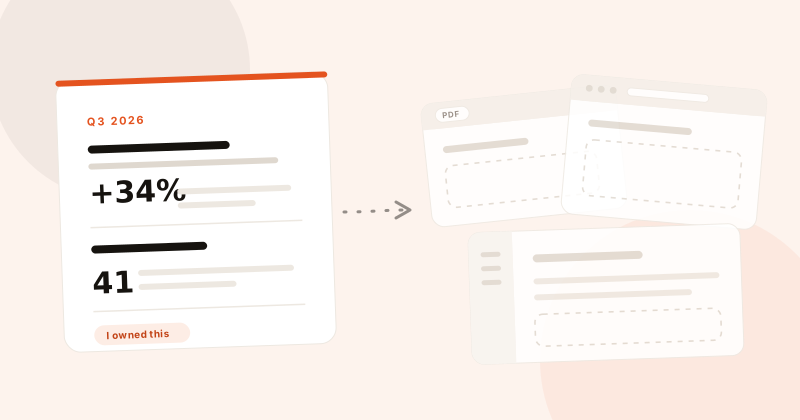
Ask ten marketers where their portfolio lives and you'll get ten different answers, most of them apologetic. A Notion page they haven't touched since 2023. A PDF named Portfolio_FINAL_v4.pdf. A Webflow site that looked incredible for three weeks and has been out of date ever since. Or, most commonly, nothing at all - just a LinkedIn profile and the hope that nobody asks.
There's no default. Designers have Behance, developers have GitHub, writers have clips. Marketers improvise, and the improvisation is usually worse than it needs to be.
Here's an honest look at what people actually use, what each one is good at, and where each one falls over.
The PDF or slide deck
What it is: a deck built in Google Slides, Keynote or PowerPoint, exported to PDF and emailed when someone asks.
Why people use it: it's the fastest thing to make, you already know the software, and it's the format hiring managers are most comfortable receiving. For agency and brand work especially, a well-built deck is still the standard - it's how case studies are presented internally, so it's the format the audience already reads fluently.
Where it breaks: it goes stale the moment you export it, and you'll never update it until the next time you need it, at which point you'll rebuild it from scratch. It isn't linkable, so it can't sit in your LinkedIn bio or your email signature. It can't be found. And every version you send is a fork - six months later you have four PDFs and no idea which one you sent to whom.
Use it if: you're interviewing for senior brand or agency roles, where a deck is the expected artifact and the craft of the deck is itself part of the assessment.
Notion
What it is: a Notion page, published to the web, with sections for your work.
Why people use it: it's free, it takes an afternoon, and marketers already live in it. It's genuinely easy to update, which matters more than it sounds - the portfolio you actually maintain beats the beautiful one you abandoned. It handles long-form case studies well, and you can link out to anything.
Where it breaks: it looks like Notion. That's fine for an internal document and it's a problem for a portfolio, because half the point of a portfolio is demonstrating that you have taste. Every Notion portfolio looks like every other Notion portfolio. The URLs are ugly unless you pay for a custom domain. And Notion's web pages load slowly and index poorly, so nobody's finding you through search.
Use it if: you want something maintained rather than beautiful, you write long case studies, and your audience is people you're sending it to directly rather than people discovering you.
Webflow, Framer or Squarespace
What it is: a proper personal website, designed by you, on your own domain.
Why people use it: it's the best-looking option by a distance, and the only one where you control everything. A well-made personal site signals seriousness in a way nothing else does. It's yours permanently - no platform can shut down and take it with them. And it's the only option that can rank in search.
Where it breaks: the time cost is brutal and it's front-loaded. Marketers routinely spend two weekends on a portfolio site, launch it, and never touch it again - because updating means opening the builder, remembering how the CMS collection works, and fighting the layout. Framer and Webflow both have real learning curves. And there's a subtler failure: it's very easy to spend three weekends on the design of a portfolio as a way of avoiding the harder work of figuring out what to put in it.
Use it if: you're freelancing or consulting, where the site is a sales asset and the investment pays for itself, or you genuinely enjoy building it.
LinkedIn, the default nobody chose
What it is: what most marketers use, by not using anything else.
Why people use it: it's where recruiters already are. It has the network effects everything else lacks. Zero setup.
Where it breaks: LinkedIn is built to list where you worked, not to show what you did. The format compresses years of work into bullet points, which is why everyone's profile reads the same - "drove significant growth," "led cross-functional initiatives," "owned the full funnel." It's a CV with a photo. There's no room for a result with context, no way to show the work itself, and the featured section is an afterthought most people fill with one link and forget.
Use it for: being findable. Not for proving anything.
What about Behance or Dribbble?
Occasionally a marketer with a creative background puts work on Behance. It mostly doesn't fit. Those platforms are built around visual craft - the image is the work, and it's judged on sight. Most marketing work isn't visual. A lifecycle programme that lifted revenue per send by half has nothing to screenshot. The one exception is brand and creative marketers with genuine campaign visuals, for whom Behance is a reasonable home for the assets, though not for the results.
Worth noting as a caution: Read.cv, which was the best-designed portfolio platform creatives had, shut down in 2025 after being acquired. Polywork closed in January 2025 having raised over $40 million. Platforms disappear. If you use one, keep your own copy of everything.
The real problem isn't the tool
Here's the thing almost every "how to build a marketing portfolio" article misses.
Marketers don't fail to have portfolios because they picked the wrong software. They fail because they have nothing to put in one.
The work happened inside systems they don't own. The dashboard belonged to their employer. The campaign got archived. The numbers were in a deck on a Drive they lost access to when they left. By the time someone asks to see their work, the evidence is gone and all that's left is a recollection of a number that felt good at the time.
Which is why so many portfolio projects die halfway through. You open Webflow, build two beautiful sections, get to the part where you need actual results to fill them with, and discover you can't remember whether it was 30% or 40%, or over what period, or what the baseline was. So you write "drove significant growth" and close the tab.
The tool decision is downstream of a documentation habit. If you have four quarters of properly recorded results, almost any of these options works. If you don't, none of them will save you.
So what should you actually do?
If you're job hunting right now: you need something linkable and fast. Notion or a dedicated portfolio tool. Don't start a Webflow build three weeks before interviews - you'll spend the time on layout instead of preparation.
If you're freelancing or consulting: build the real site. It's a sales asset, it pays for itself, and the polish matters to clients in a way it doesn't to hiring managers.
If you're employed and thinking ahead: the format matters far less than the habit. Pick whatever you'll actually update, and update it quarterly, while you still have access to the numbers.
If you're presenting to a senior stakeholder or at peer review: a deck, still. It's the format that room reads fastest.
And whatever you choose, do the unglamorous part first. Once a quarter, write down what you did, the number it moved, the timeframe, and what you'd honestly claim. Twenty minutes. That note is the portfolio. Everything else is presentation.
We built Seen. because we kept watching good marketers hit exactly that wall - plenty of work, no record of it. It turns your campaigns and results into a profile you can share on LinkedIn, send to a recruiter, or bring to a review. Have a look - or just open a note and start writing things down. That part matters more.